
Built in the messy middle.
More than a decade in product marketing has taught me that the best strategies aren't born in perfect conditions. They're built in the messy middle of competing priorities, imperfect information, and real business decisions.
The work below is where that experience meets execution.
Field Notes
When Customer Intelligence Meets Product Strategy
When Customer Intelligence Meets Product Strategy
How I connected siloed business intelligence to a quarterly, collaborative approach to product prioritization.
The outcome
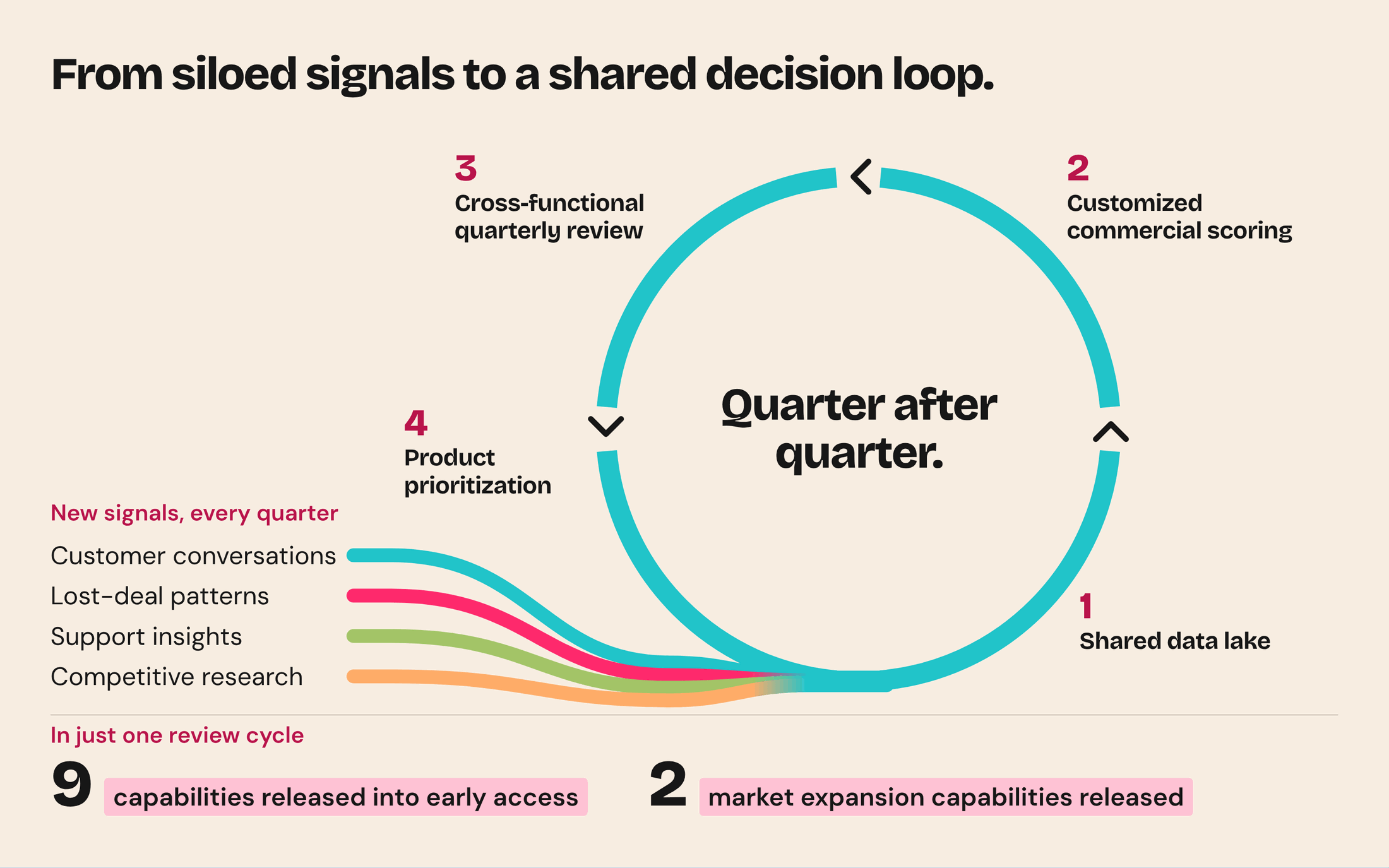
15 capability requests evaluated and prioritized. Nine incorporated into an early-access release, alongside two market expansion capabilities.
The work also established a quarterly practice for bringing customer and market evidence into product investment discussions.
The challenge: The data existed. The fuller picture didn't.
An established compliance technology solution needed modernization. Customer expectations were changing, competitors were advancing, and teams were evaluating success through their own business-unit metrics.
Support, Sales, and other teams each had valuable information, but it lived in separate systems and was rarely examined together. Revenue performance, support activity, customer experiences, and market signals each told part of the story. None told the whole story on its own.
The opportunity was to connect those perspectives so product priorities reflected the customer and commercial reality, not just one team's view.
What I did: Bring the market into product prioritization.
Access to a shared data lake made it possible to connect intelligence across teams. Each quarter, I brought customer conversations, lost-deal patterns, support insights, and competitive research into a commercial learning review with the Product team.
I adapted a RICE-style scoring framework to incorporate customer needs, competitive gaps, commercial opportunity, and emerging market requirements alongside development considerations.
Rather than presenting a ranked list, I showed stakeholders the underlying evidence and scoring criteria, invited them to challenge assumptions, and refined the model with their input. Together, we could evaluate priorities and make the tradeoffs visible.
In one review cycle, we evaluated 15 capability requests. The combined evidence also revealed a broader customer need: confidence in the accuracy, traceability, and defensibility of the information behind their reporting.
What changed
The research informed an early-access release incorporating nine prioritized requests and two market expansion capabilities.
More importantly, the approach became a standard quarterly practice. Teams could bring their intelligence into the same conversation, review the evidence together, challenge assumptions, and develop a more complete understanding of customer needs and commercial priorities.
My contribution was connecting that evidence and helping establish a repeatable, collaborative process for informing product investment decisions.
The takeaway
The real value wasn't just better prioritization. It was creating a shared understanding that teams could build on, quarter after quarter.
By bringing previously siloed intelligence together and establishing a consistent review process, we created a fuller picture of the business and a more collaborative way to decide what mattered next.
Turns Out, Those Lost Deals Were Gold.
Turns Out, Those Lost Deals Were Gold.
How lost-deal patterns revealed a $2.2 billion market opportunity and helped shape a new direction for portfolio growth.
The outcome
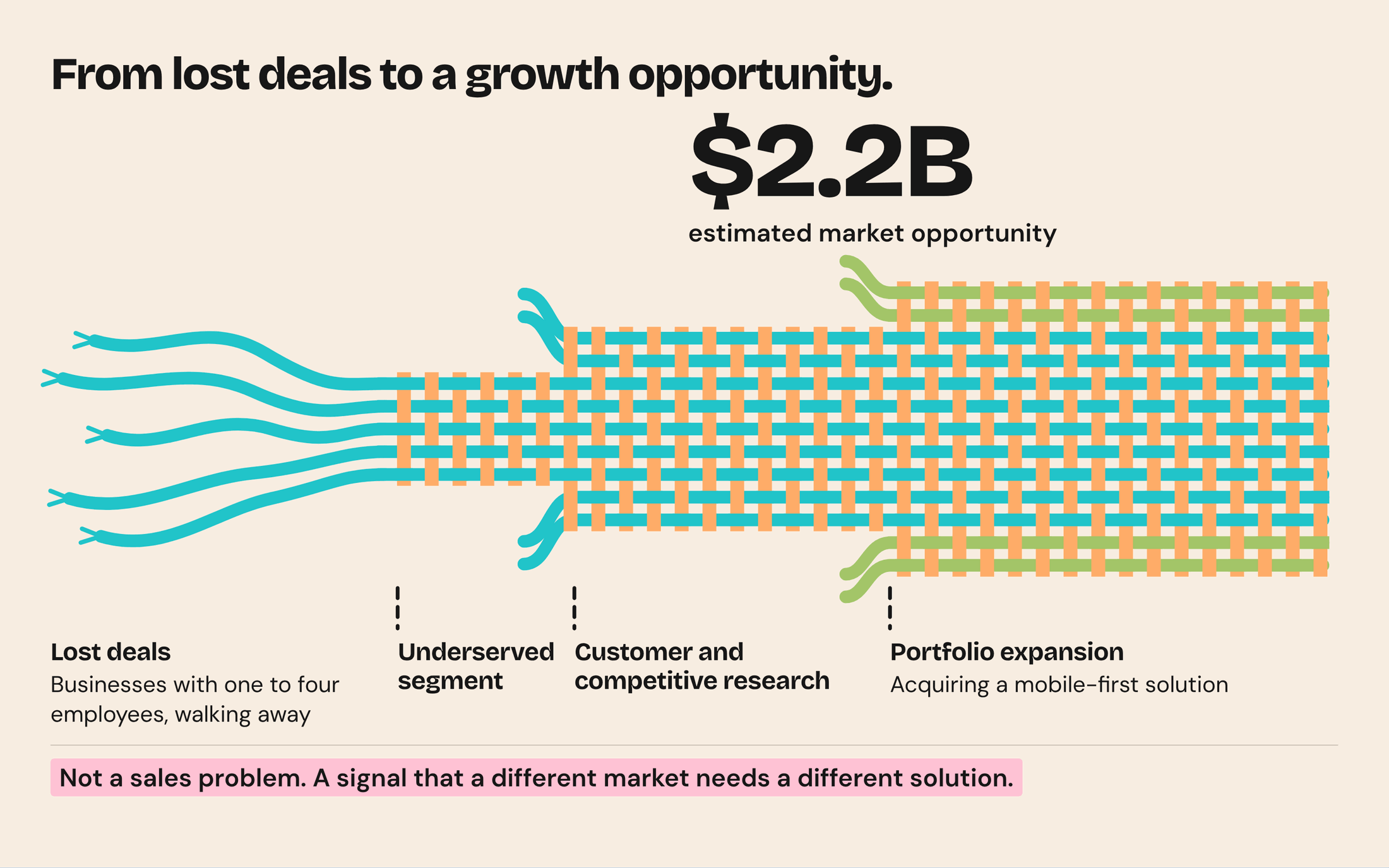
An estimated $2.2 billion market opportunity identified and presented to executive leadership, helping inform the pursuit of acquisition-led portfolio expansion.
The research gave leadership a clearer understanding of an underserved customer segment, the commercial opportunity it represented, and what it would take to compete.
The challenge: We were losing customers we weren't built to serve.
An established software business was competing in a market with customers of very different sizes and operational needs.
Our existing solution served more complex businesses well. But lost-deal analysis revealed a recurring pattern among smaller prospects: businesses with one to four employees were walking away because the solution offered more sophistication than they needed.
The question wasn't simply how to win those deals back.
It was whether these prospects represented a meaningful market opportunity, and whether our existing product was the right way to serve them.
What I did: Follow the pattern beyond the lost deal.
I connected win-loss insights with market sizing, competitive pricing research, and customer needs to understand the opportunity beyond individual sales outcomes.
The research helped establish the size of the underserved segment and the capabilities smaller businesses expected, particularly around simpler, mobile-friendly workflows.
Working with Product, Technology, and other cross-functional partners, I helped translate those findings into commercial and product requirements that could inform expansion options.
The analysis pointed to an important tradeoff: entering the segment could create meaningful growth potential, but serving it effectively would require a different product experience and economic model.
Rather than treating the problem as a messaging or sales execution gap, I presented the opportunity as a broader portfolio decision.
What changed
The research revealed an estimated $2.2 billion market opportunity in an underserved customer segment and gave executive leadership a clearer understanding of what it would take to compete.
By connecting lost-deal patterns with customer needs, competitive intelligence, and market sizing, I helped shift the conversation from improving sales performance to evaluating a new direction for portfolio growth.
The findings informed leadership's decision to pursue acquisition opportunities that could bring a mobile-first solution into the portfolio and expand the business's reach into the downmarket segment.
The takeaway
Sometimes a lost deal isn't a sales problem. It's a signal that a different market needs a different solution.
By connecting individual losses to a broader market pattern, we moved the conversation beyond how to sell the existing product and toward where the business could grow next.
The Business of Care Is Still About People.
The Business of Care Is Still About People.
How I connected health plan priorities, care-team trust, and patient needs to help turn a healthcare pilot into a scalable service.
The outcome
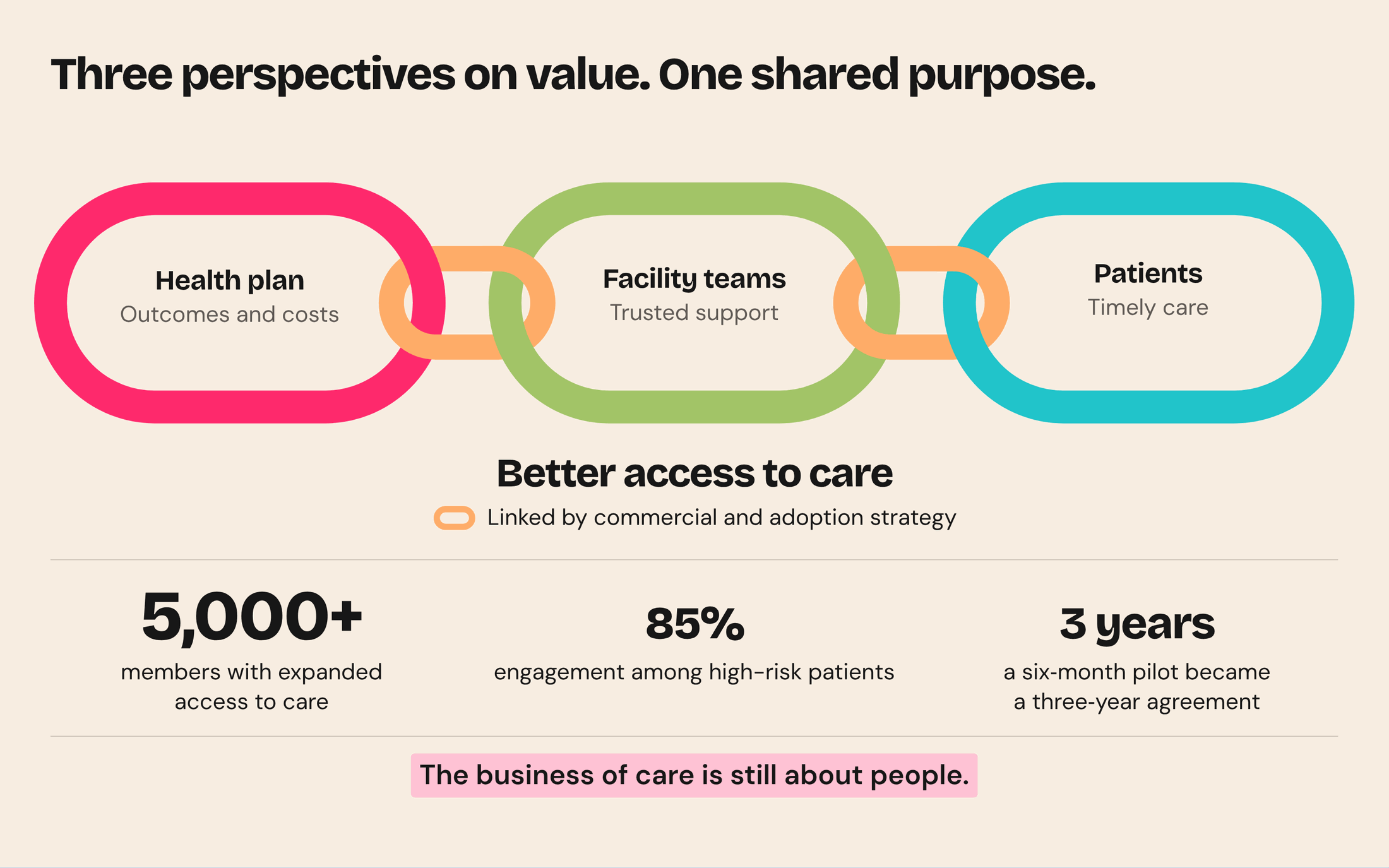
A six-month pilot became a three-year agreement, expanding access to care for more than 5,000 members nationwide.
The cross-functional effort also achieved 85% engagement among high-risk patients, with reported reductions in hospital readmissions of up to 13%.
The challenge: Three perspectives. One shared purpose.
Patients with complex care needs were driving a disproportionate share of healthcare spending. Many lived in long-term care facilities where limited clinical resources, particularly after hours, could contribute to avoidable emergency department visits.
We had an opportunity to bring additional clinical support into those environments. But making the service work required aligning three perspectives.
Health plans needed evidence of better outcomes and sustainable costs. Facility staff needed clinical support they could trust within their existing workflows. And patients needed timely access to quality care.
The buyer could fund the solution. The care teams could make it work. The patients were the reason it mattered.
What I did: Connect the commercial promise to adoption.
Working with clinical, operations, sales, and business leadership teams, I helped shape the offering's value proposition, pricing and packaging discussions, and go-to-market approach.
We positioned the service around earlier clinical intervention, improved access to care, and alternatives to unnecessary emergency department visits. That commercial work supported a six-month pilot with a health plan partner.
But securing the pilot was only the beginning.
During a week onsite in long-term care facilities, I saw how important trust was to implementation. Working with clinical teams and community liaisons, I helped develop a repeatable engagement approach built around staff appreciation, education, and relationship-building.
We established shared activities and performance measures to support consistent implementation, while monitoring emergency department utilization for signals that adoption barriers needed attention.
What changed
The pilot helped demonstrate the value of the care model and establish a foundation for broader adoption.
The cross-functional effort supported a three-year agreement, expanded access for more than 5,000 members, and achieved 85% engagement among high-risk patients. Reported results also included up to a 13% reduction in hospital readmissions and more than $7.1 million in healthcare savings for a 1,000-patient cohort.
The work established a more consistent approach to facility engagement, measurement, and responding to adoption challenges.
The takeaway
The business of care is still about people.
A signed contract can establish commercial value. Adoption can demonstrate operational value. But the real measure of success is whether those efforts translate into better access to care for the people who need it.
That's what made this work meaningful to me. We weren't simply commercializing a healthcare service. We were helping make additional clinical support available to people who needed it.
One PMM Function. Multiple Go-to-Market Motions.
One PMM Function. Multiple Go-to-Market Motions.
How I helped establish a shared operating system for informed decisions, transparent tradeoffs, and cross-functional accountability across five independently led businesses.
The outcome
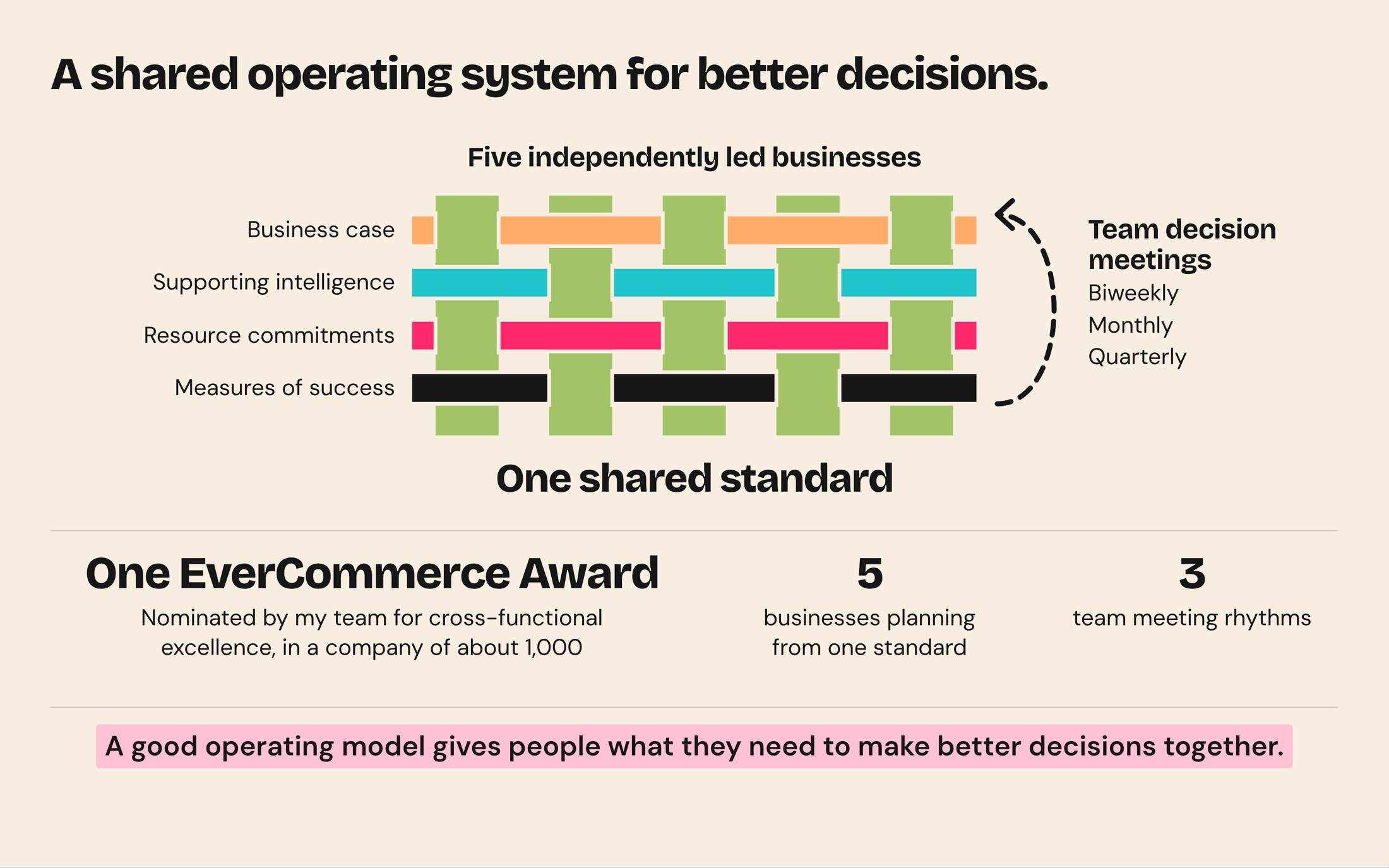
Established a shared cross-functional decision-making approach across five independently led businesses, bringing greater transparency to priorities, resource commitments, and commercial tradeoffs.
Through recurring biweekly, monthly, and quarterly conversations, teams had a consistent way to bring their expertise and intelligence together, evaluate progress against business goals, and make informed decisions about what came next.
For this work, I was nominated by my team and received the One EverCommerce Award, a company-wide recognition within an organization of approximately 1,000 employees.
The challenge: Five businesses. Five sets of priorities.
Five independently led businesses shared centralized Marketing resources while pursuing different products, customers, and commercial objectives.
Each business had opportunities it wanted to pursue, but requests didn't always arrive with the information, lead time, or cross-functional commitments needed to evaluate them effectively.
Without shared expectations, it was difficult to assess competing priorities, understand resource requirements, or have informed conversations about what was realistic.
The opportunity was to create a common understanding of what strong go-to-market planning required, while giving each business the flexibility to make its own informed decisions.
What I did: Establish the standard together.
I brought Marketing colleagues and cross-functional stakeholders together to define what we considered best-practice marketing campaigns and what information was needed to make informed investment decisions.
Together, we established expectations for business cases, objectives, supporting intelligence, resource commitments, timelines, and measures of success.
We also introduced recurring biweekly, monthly, and quarterly meetings to bring perspectives together, review progress against revenue goals, discuss changing priorities, and revisit commitments as new information emerged.
The standard wasn't an all-or-nothing requirement. When a business couldn't provide everything needed for a best-practice campaign, we could still move forward. But now everyone had a shared basis for discussing how that choice might affect scope, timing, resources, or expected outcomes.
By developing these expectations alongside Marketing, we established a more consistent and transparent way for stakeholders to evaluate opportunities and make commitments together.
What changed
The approach gave stakeholders a more consistent way to bring their expertise and intelligence into planning conversations, evaluate priorities, and understand the tradeoffs behind different decisions.
Recurring reviews created opportunities to examine progress toward commercial goals, discuss constraints, and make adjustments together.
Rather than leaving individual teams to negotiate expectations independently, we established a shared standard for understanding what was possible and what each function needed to contribute.
The takeaway
A good operating model doesn't make decisions for people. It gives people what they need to make better decisions together.
We didn't eliminate competing priorities, resource constraints, or the realities of supporting five different businesses. We created a shared understanding of what was possible, what each team needed to contribute, and what tradeoffs came with different choices.
What made this work meaningful was seeing teams come together around a more transparent and collaborative way of making decisions. Being nominated by my colleagues and receiving the One EverCommerce Award made that especially rewarding.
It reinforced something I believe about leadership: the goal isn't to have all the answers. It's to create the conditions where people can bring their expertise together and make better decisions.
Got big ideas? Real-world complications?
Whether you're building something new, navigating a complex commercialization challenge, or looking for someone who can connect the dots across teams, I'd love to hear what you're working on.