
Field-tested thinking. Tools for the real world.
Practical frameworks, diagnostics, and working tools for product marketers navigating the messy middle between strategy and execution.
Built from real-world challenges. Designed to help you ask better questions, make more informed decisions, and put good thinking to work.
Better Intelligence · Better Decisions · Better Commercial Outcomes
Free to explore. Free to use.
Explore the Field Guides
Not every challenge needs another playbook. Sometimes the first step is figuring out what you're actually dealing with.
Explore practical frameworks, diagnostics, and real-world perspectives that help you recognize patterns, challenge assumptions, and make a more informed next move.
Select a resource to explore the thinking, see when it applies, and learn how to put it to use.
The Field Guide

GTM Craftsmanship Ladder
You can't build toward a more mature GTM organization without understanding where you are today. Explore four stages of GTM maturity and what it takes to move forward.
Explore the guideRead the text version
The GTM Craftsmanship Ladder. How GTM teams actually evolve.
Level 1: Fragmented (no shared truth). Build: ICP Definition. Problem → Use Case Map. Basic Positioning. AI support → Summarization models (LLMs like GPT / Claude). Use for: organizing messy inputs, extracting patterns.
Level 2: Misaligned (docs exist, not used). Build: Messaging Framework. Sales Talk Tracks. One Story Doc. AI support → Reasoning models (advanced GPT / Claude models). Use for: comparing narratives, identifying inconsistencies.
Level 3: Structured (clear but not operational). Build: Knowledge Hub. Launch Narrative Template. AI-Ready Inputs. AI support → Generation + workflow models. Use for: drafting messaging, adapt content, scaling outputs.
Level 4: Systematized (repeatable + scalable). Build: AI Workflows. Feedback Loops. Continuous Optimization.
Don't choose a model first. Choose the job.
What it's for
Not every GTM organization operates at the same level of maturity. And what works for a highly developed team may not be realistic for one that's still building its foundation.
The GTM Craftsmanship Ladder helps you understand your organization's current maturity across four stages: Fragmented, Misaligned, Structured, and Systematized.
When to use it
When you're trying to improve your GTM function but aren't sure where to start.
Maybe you're introducing new processes, expanding your team's responsibilities, or trying to build capabilities your organization isn't quite ready to support.
Before deciding what comes next, understand where you are today.
How to use it
Review the four stages and identify which most closely reflects how your GTM organization operates today.
Look at what your team can consistently do, not just what it aspires to do.
Then ask: What's realistic for us to improve at our current stage, and what capabilities do we need to build to reach the next one?
Focus on the next stage rather than trying to jump straight to the most advanced model.
What it helps you do
Understand your GTM organization's current maturity, identify the capabilities worth developing, and make more intentional decisions about where to invest your efforts.
You can't build the GTM organization you want without understanding the one you have.
The Field Guide
Building a VoC Engine That Drives Action
Customer feedback is everywhere. Turning it into intelligence your organization can actually use is another story.
Explore the guide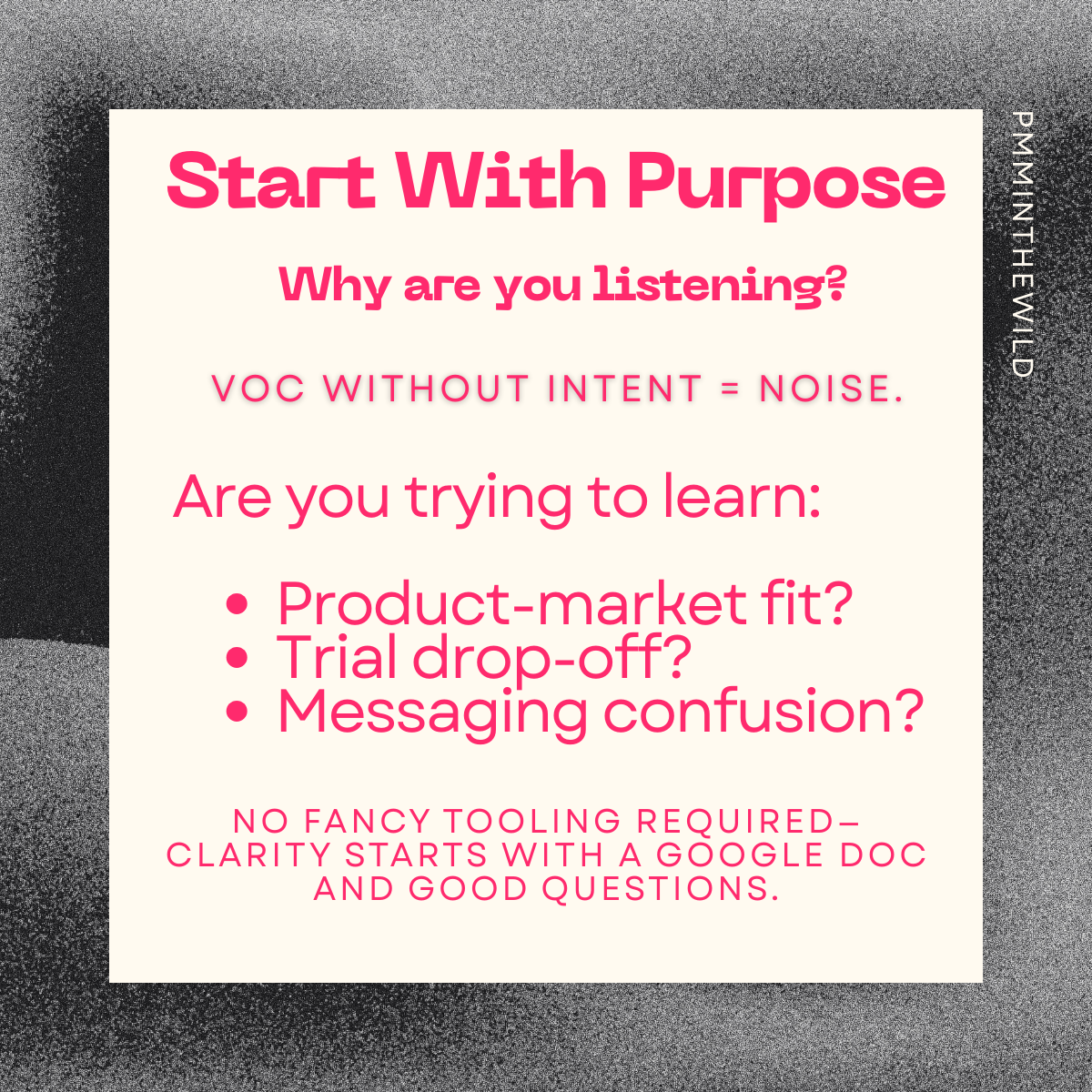
Read the text version
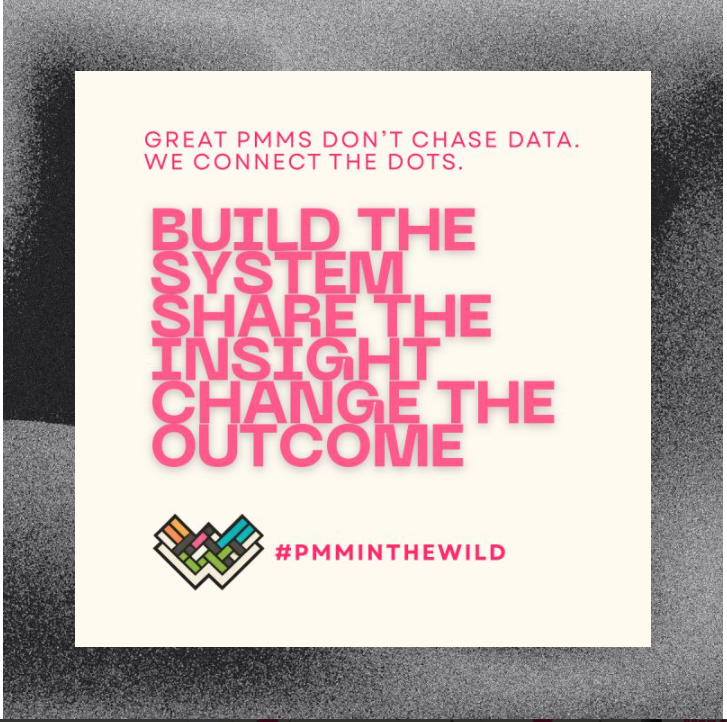
Slide 1. Great PMMs don't chase data. We connect the dots. Build the system. Share the insight. Change the outcome. #PMMINTHEWILD
Slide 2. Start With Purpose. Why are you listening? VoC without intent = noise. Are you trying to learn: Product-market fit? Trial drop-off? Messaging confusion? No fancy tooling required—clarity starts with a Google Doc and good questions.
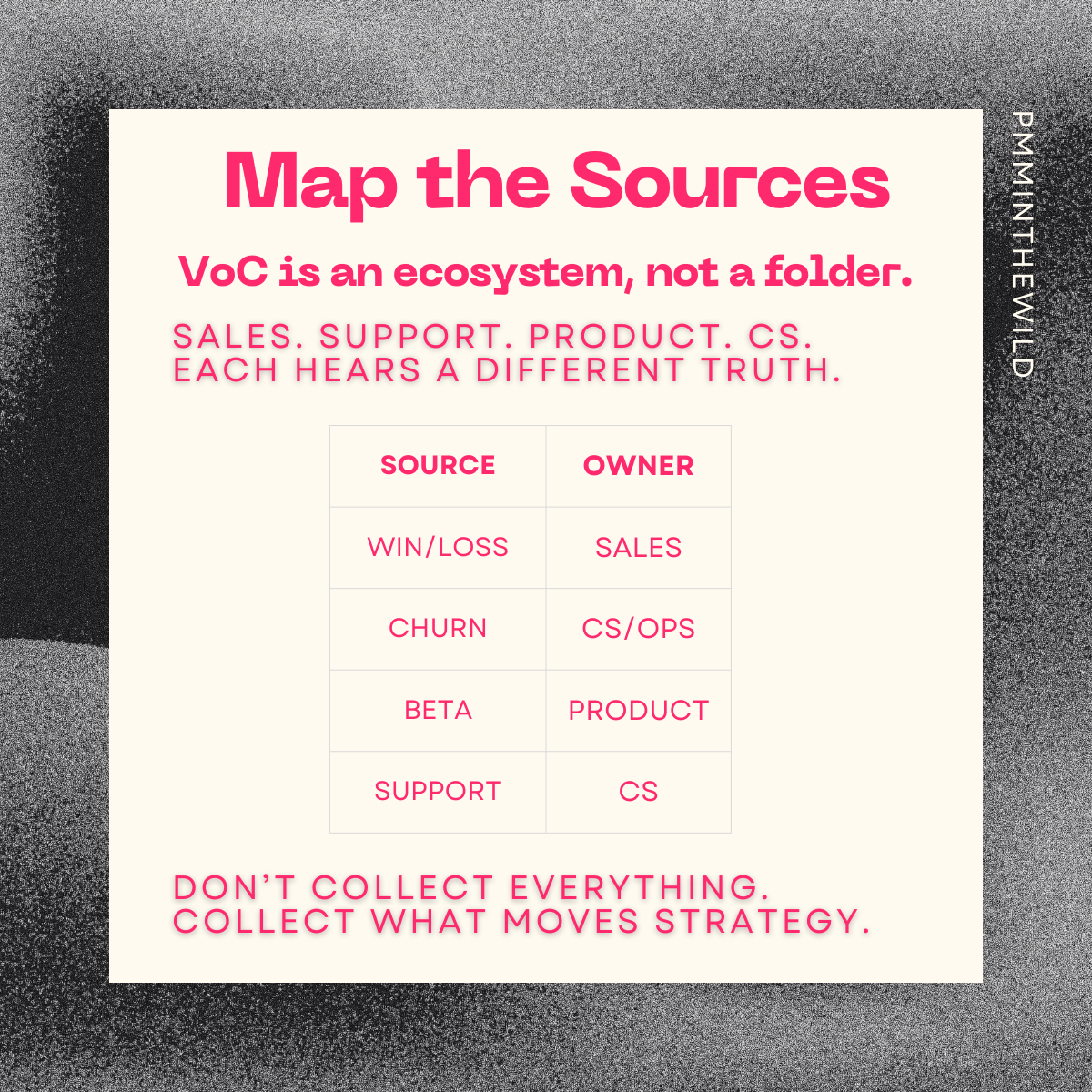
Slide 3. Map the Sources. VoC is an ecosystem, not a folder. Sales. Support. Product. CS. Each hears a different truth. Source and owner: Win/loss, Sales. Churn, CS/Ops. Beta, Product. Support, CS. Don't collect everything. Collect what moves strategy.
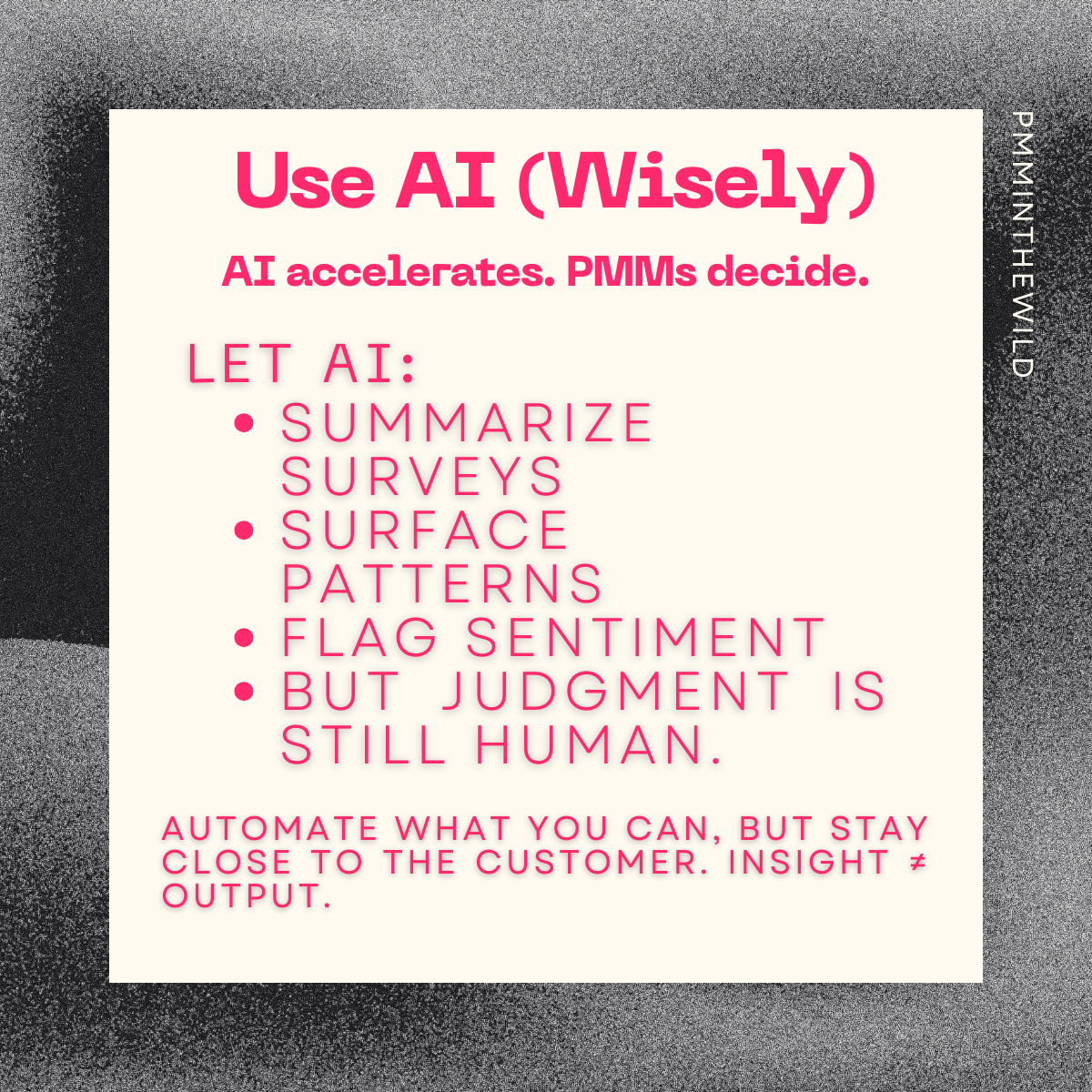
Slide 4. Use AI (Wisely). AI accelerates. PMMs decide. Let AI: Summarize surveys. Surface patterns. Flag sentiment. But judgment is still human. Automate what you can, but stay close to the customer. Insight ≠ output.
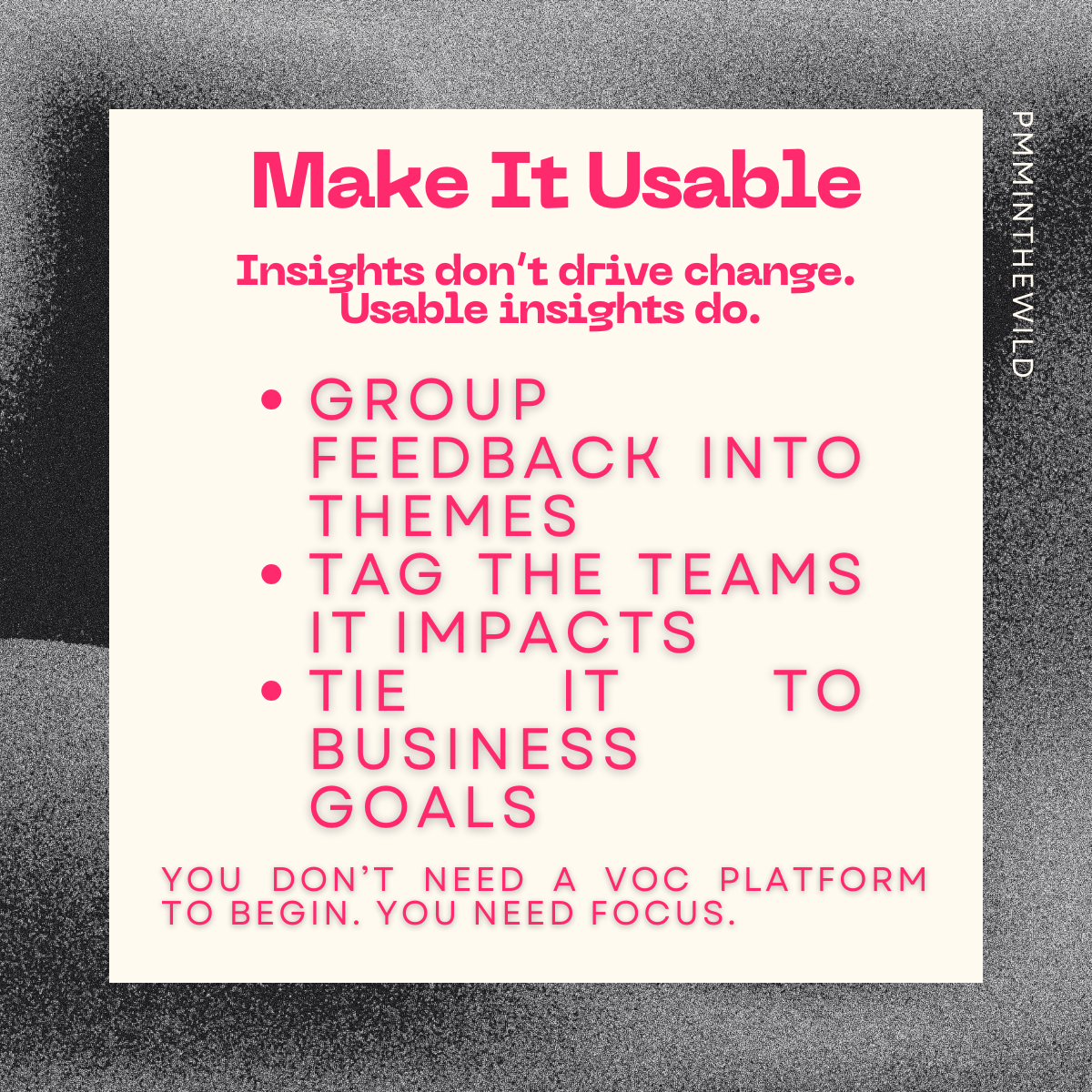
Slide 5. Make It Usable. Insights don't drive change. Usable insights do. Group feedback into themes. Tag the teams it impacts. Tie it to business goals. You don't need a VoC platform to begin. You need focus.
Slide 6. Teach Teams to Fish. VoC shouldn't live with one team. Don't just share insights—build capability. Translate data into stories. Run VoC working sessions. Celebrate wins driven by customer truth. When teams learn how to listen, alignment follows.
What it's for
Most organizations aren't short on customer feedback. It's scattered across sales calls, support tickets, customer conversations, and systems that rarely talk to each other.
This guide introduces five principles for connecting those inputs and turning customer feedback into intelligence that informs business decisions.
When to use it
When teams are hearing different things from customers, insights aren't reaching the people who need them, or feedback is being collected without a clear purpose.
If everyone has customer data but nobody has the full picture, start here.
How to use it
Walk through the five principles:
- Start With Purpose. Know what you're trying to learn.
- Map the Sources. Find where customer intelligence already lives.
- Use AI (Wisely). Connect patterns without confusing AI-generated insights with verified evidence.
- Make It Usable. Translate findings into insights teams can act on.
- Teach Teams to Fish. Build shared habits for using customer intelligence.
As you go, ask: Where are we losing the connection between what customers tell us and what our organization does about it?
Identify one gap worth addressing first.
What it helps you do
Recognize where customer intelligence is getting lost, disconnected, or overlooked, and identify opportunities to make it more actionable.
Because the point of listening to customers isn't to collect feedback. It's to make better decisions about what you build, prioritize, and improve.
The Field Guide
The Decision Loop Stress Test
Your organization is making decisions. But is it learning from them? Find where evidence, accountability, and action stop connecting across your GTM efforts.
Explore the guide


Read the text version
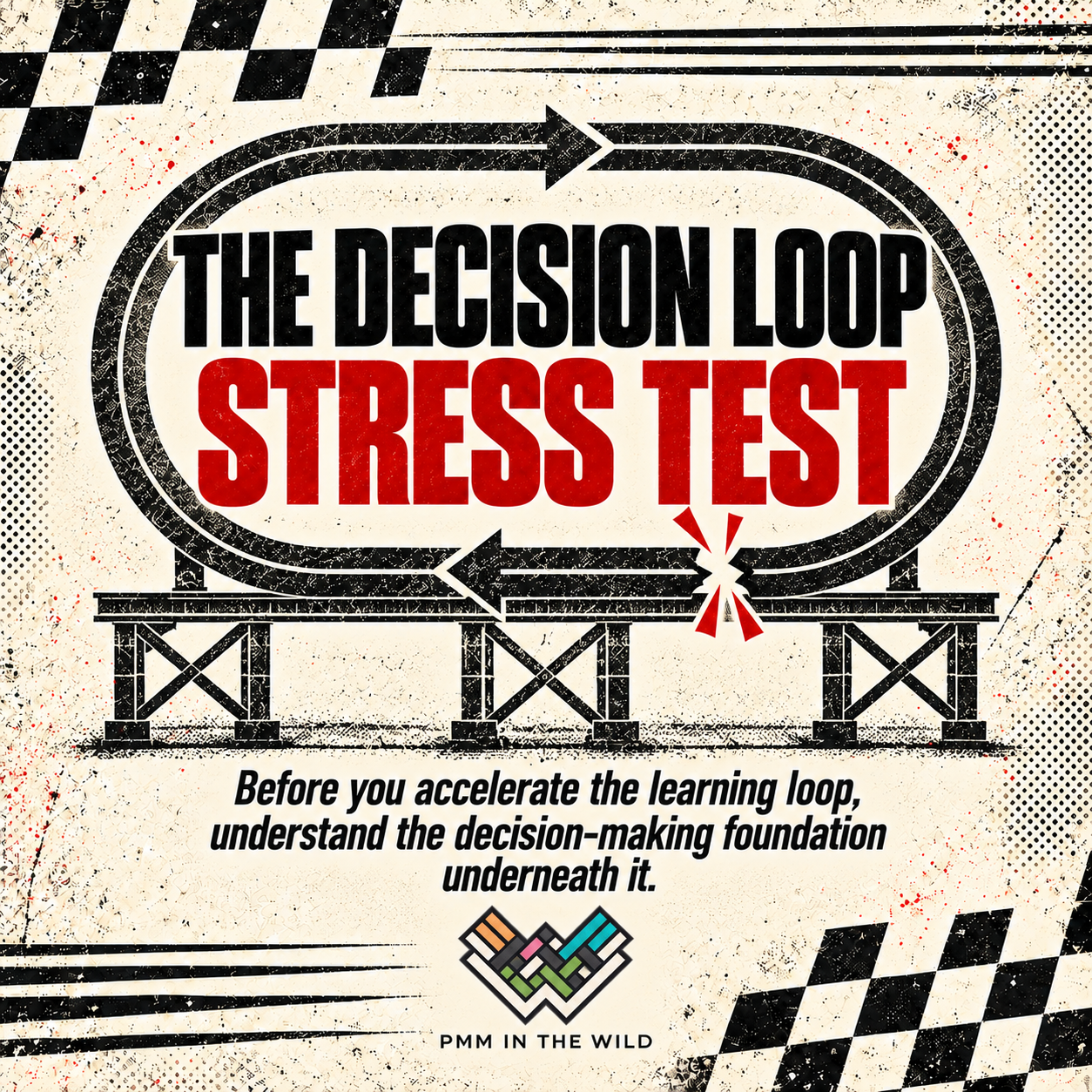
The Decision Loop Stress Test. Before you accelerate the learning loop, understand the decision-making foundation underneath it. PMM IN THE WILD
Start with the bet. Ask your team: 1. What outcome are we trying to change? 2. What bet are we making to change it? 3. What evidence justified that bet? These questions tell you whether the team is starting from a shared decision.
What are we testing? How does your organization turn a bet into learning? Can your team consistently move from: Objective → Bet → Evidence → Signal → Learning → Decision. The goal isn't to move faster for the sake of moving faster. It's to recognize what the evidence is telling you—and know what to do next.
Then test the loop. 4. What signals would indicate progress? 5. When will we reassess? 6. Who can continue, adjust, or stop the bet? 7. How does that decision change the work? These questions tell you whether the organization can learn from the bet.
Don't answer alone. Compare answers across functions. Ask Product. Revenue. GTM. Engineering. Finance. Leadership. You aren't looking for seven perfectly worded answers. You're looking for the pattern across them.
Your foundation may be missing or fragmented. Missing: The questions don't have clear or consistent answers yet. Fragmented: The answers exist, but they change depending on which function you ask. The organization may be making decisions—but not from shared context.
Or it may be rigid or adaptive. Rigid: The team shares the same answers, but struggles to revisit the bet when evidence changes. Adaptive: The team can make, evaluate, and redirect a bet without losing discipline. Having a loop is not enough. It has to be able to learn.
Why this matters for PMM. You don't have to own the system to understand it. PMM can: Surface conflicting assumptions. Separate evidence from opinion. Identify what is still unknown. Show the commercial consequences. And clarify what the team needs to decide next.
Know your starting point. The goal isn't to diagnose the entire organization from the middle. It's to understand the decision-making environment you're working within—so you can move forward with more clarity.
What it's for
Organizations make decisions every day. But making decisions and learning from them are two different things.
The Decision Loop Stress Test helps you examine how your organization moves from objective → bet → evidence → signal → learning → decision, and identify where that process loses momentum or breaks down.
When to use it
When teams keep revisiting the same conversations, repeating familiar approaches, or moving from one initiative to the next without examining what they've learned.
And don't wait for something to go wrong.
Successful launches deserve the same scrutiny. Understanding why something worked is just as important as understanding why it didn't.
How to use it
Choose a recent GTM initiative, successful or otherwise, and walk through these questions:
- What outcome were we trying to change?
- What bet did we make, and what evidence supported it?
- What signals told us whether it was working?
- When did we reassess what we were learning?
- Who had the authority to continue, adjust, or stop?
- How did those decisions change the work?
Then identify which condition best reflects your organization's decision loop:
- Missing: No consistent learning or decision process.
- Fragmented: Pieces exist, but they aren't reliably connected.
- Functioning but rigid: A process exists but struggles to adapt.
- Adaptive: Evidence consistently informs decisions and subsequent action.
Look for where the connections break, not just whether individual steps exist.
What it helps you do
Identify where goals, evidence, learning, and decisions become disconnected across your GTM efforts.
As a PMM, you may not own every decision, but your cross-functional perspective puts you in a unique position to recognize these gaps, bring them into the conversation, and help teams build a stronger GTM approach.
A functioning learning loop doesn't just tell you what happened. It helps your organization decide what to do differently, what to repeat, and what to stop.
The Field Guide

The AI Adoption Tax
Your AI solution might deliver real value. But what does the customer have to change, trust, or give up to realize it?
Explore the guide


Read the text version
The AI Adoption Tax. What's actually on the bill? PMM IN THE WILD
Trust Tax. How much control are you asking them to hand over? Summarize → Recommend → Decide → Act. More autonomy = more trust to earn.
Workflow Tax. How much has to change before AI creates value? Same workflow → lower tax. New process + new behavior → higher tax. More change requires more value.
Proof Tax. How hard is it to prove it worked? Clear before + after → lower tax. Fuzzy outcome + long lag → higher tax. Harder to prove = harder to commercialize.
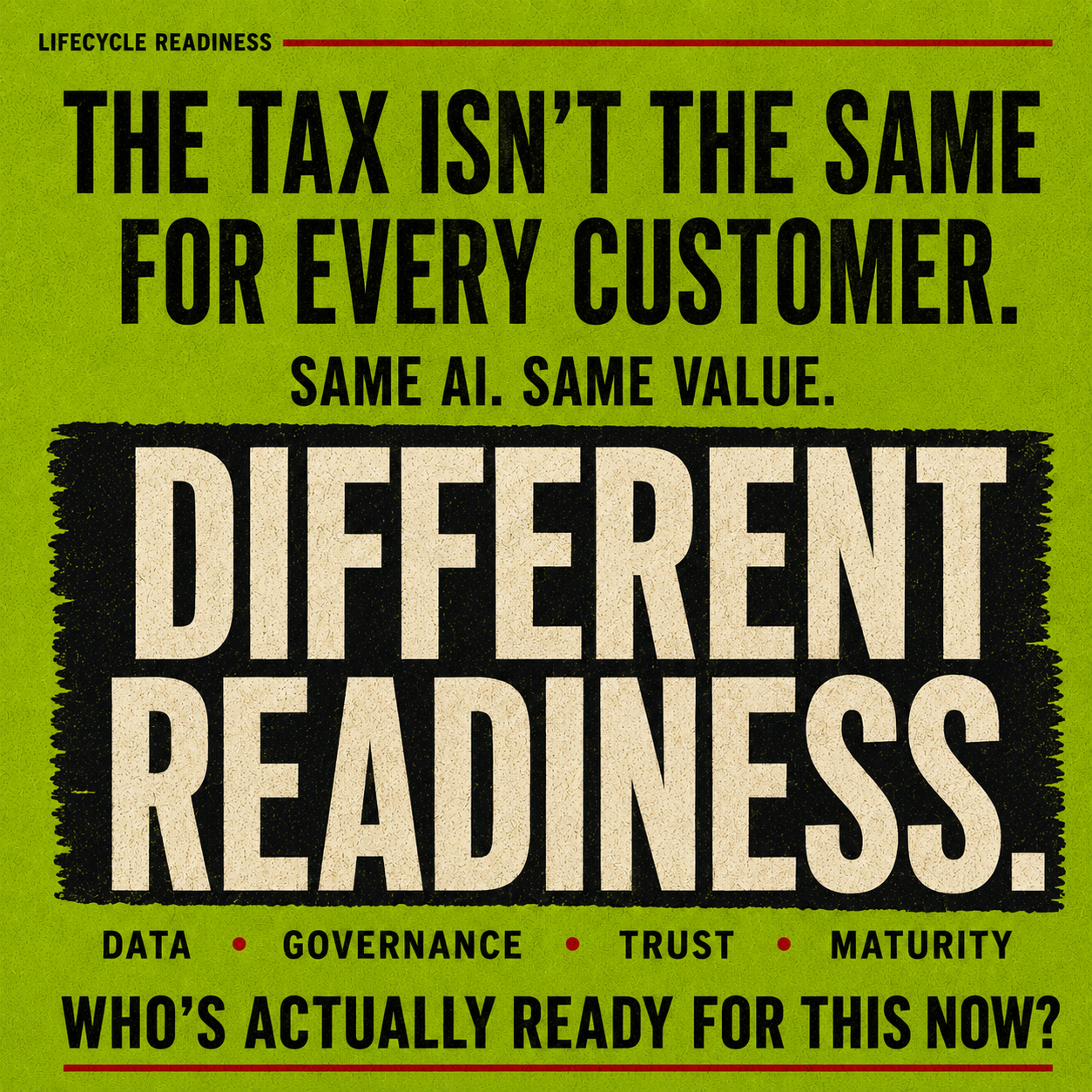
Lifecycle Readiness. The tax isn't the same for every customer. Same AI. Same value. Different readiness. Data • Governance • Trust • Maturity. Who's actually ready for this now?
Before you commercialize AI... Is the value worth the change?
What it's for
A compelling AI capability doesn't automatically translate into customer adoption.
The AI Adoption Tax helps you examine the friction customers experience between recognizing a solution's value and actually putting it to work.
It introduces four dimensions: Trust, Workflow, Proof, and Lifecycle Readiness.
When to use it
When customers understand your AI solution's value but hesitate to adopt it, struggle to move beyond a pilot, or aren't realizing the outcomes you promised.
It's also useful before launch, when you're evaluating what customers will need to change to adopt a new capability.
How to use it
Examine your offering through four questions:
- Trust: What judgment, control, or accountability are we asking customers to hand over?
- Workflow: What established processes or behaviors must change?
- Proof: What evidence will customers need before they believe the value is real?
- Lifecycle Readiness: Does the customer have the organizational capacity to adopt, operationalize, and sustain the change?
Consider how those answers differ across customer segments.
Then ask: Which source of friction are we expecting our messaging or sales team to overcome when the real issue may require a different commercial approach?
What it helps you do
Recognize adoption barriers that product capabilities and messaging alone cannot resolve.
Use those insights to inform positioning, customer education, enablement, implementation expectations, and commercialization priorities.
The cost of adoption isn't just what customers pay. It's what they have to change to realize the value you're promising.
The Field Guide

The AI Commercialization Gap
Launching an AI capability is one milestone. Getting customers to understand, adopt, and realize its value is an entirely different challenge.
Explore the guide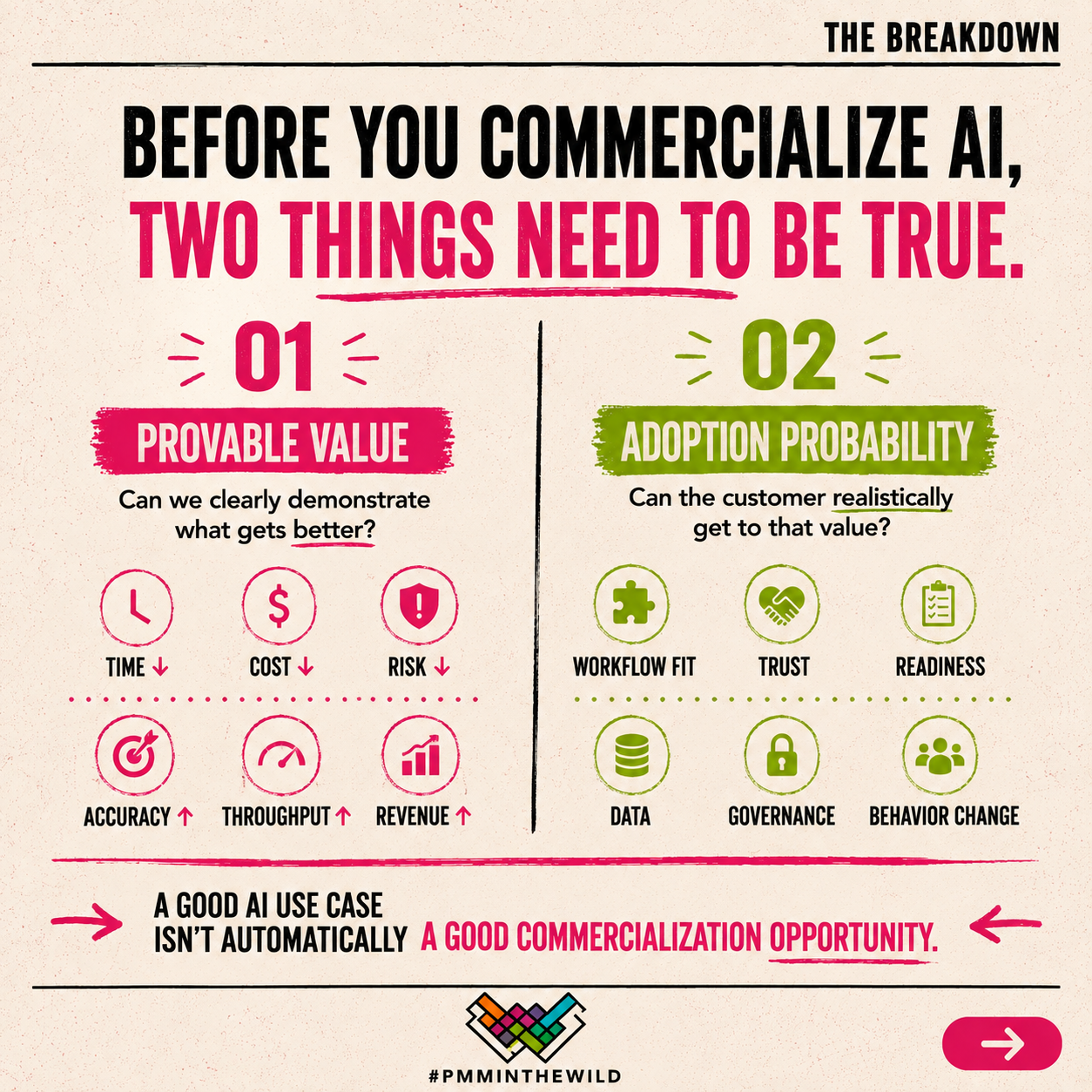


Read the text version
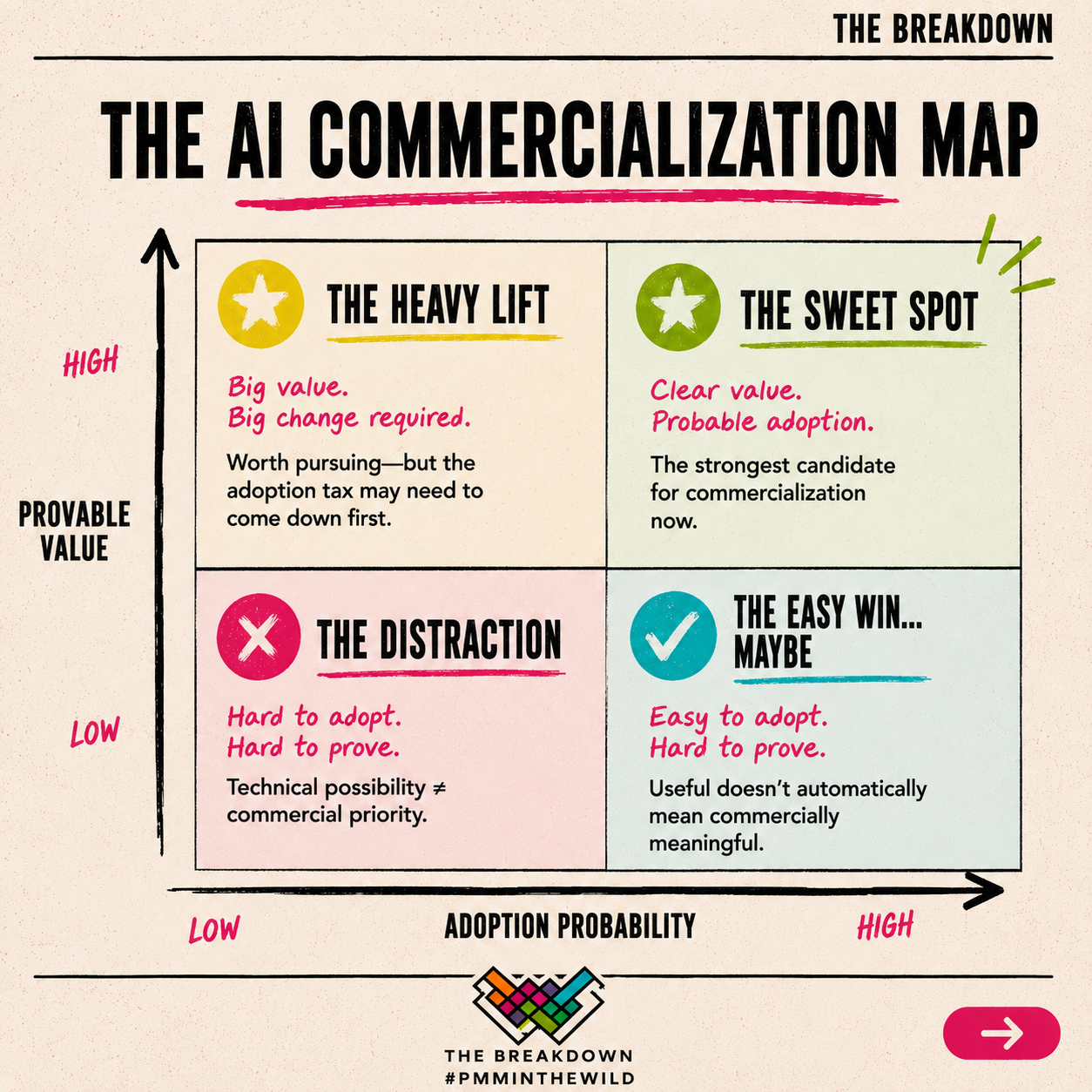
The biggest AI opportunity isn't always the best one. A practical framework for finding where AI is actually ready to commercialize. Provable value × Adoption probability. #PMMINTHEWILD
Before you commercialize AI, two things need to be true. 01 Provable value: Can we clearly demonstrate what gets better? Time ↓ Cost ↓ Risk ↓ Accuracy ↑ Throughput ↑ Revenue ↑. 02 Adoption probability: Can the customer realistically get to that value? Workflow fit. Trust. Readiness. Data. Governance. Behavior change. A good AI use case isn't automatically a good commercialization opportunity.
The AI Commercialization Map. Provable value (low to high) against adoption probability (low to high). The Heavy Lift: Big value. Big change required. Worth pursuing—but the adoption tax may need to come down first. The Sweet Spot: Clear value. Probable adoption. The strongest candidate for commercialization now. The Distraction: Hard to adopt. Hard to prove. Technical possibility ≠ commercial priority. The Easy Win... Maybe: Easy to adopt. Hard to prove. Useful doesn't automatically mean commercially meaningful.
The value can be real and the adoption tax can still kill it. Every AI capability asks the customer to absorb some amount of change before they ever realize the value. Workflow tax: How much does the way I work have to change? Trust tax: How much judgment am I being asked to give AI? Learning tax: What do people have to learn—or unlearn? Implementation tax: What data, integration, governance, or approvals come first? Proof tax: How long before I know this actually worked? The higher the tax → the lower the probability of adoption.
Start asking: Where can AI create measurable value at a point where customers are actually ready to adopt it? Provable value: The value is clear, measurable, and proven. × Adoption probability: The adoption is likely, timely, and set up to win. = Commercialization priority: The AI opportunity that deserves your focus. PMM shouldn't just help take AI to market. We should help identify where AI is ready for the market.
What it's for
Bringing an AI capability to market doesn't mean you've successfully commercialized it.
The AI Commercialization Gap helps you examine the journey between product availability and realized customer value.
It follows six connected stages: Product → Understanding → Trust → Adoption → Behavior Change → Realized Value.
When to use it
When your AI launch is generating interest but adoption isn't following, customers are using the capability without realizing its promised value, or teams are declaring success before understanding what happens after launch.
It's also useful during commercialization planning, before those gaps become customer problems.
How to use it
Walk through the six stages and ask:
- Product: What capability are we bringing to market, and what problem does it solve?
- Understanding: Do customers understand where and why it matters?
- Trust: What gives customers confidence to rely on it?
- Adoption: Are customers actually putting it to use?
- Behavior Change: Is the capability changing how customers work?
- Realized Value: Can customers recognize and demonstrate the outcomes we promised?
Identify where your organization has evidence of progress and where you're relying on assumptions.
Then ask: Where are we declaring success before we've demonstrated customer value?
What it helps you do
Recognize where your commercialization efforts are falling short of customer outcomes and identify what needs attention beyond launch.
Use the framework to align Product, Marketing, Sales, and Customer Success around the full journey from capability to realized value.
A successful launch puts your product in the market. Successful commercialization makes its value real for the customer.
Put It to Work
Less spinning your wheels. More moving things forward.
These free, guided tools help you work through real challenges, organize what you know, and make more informed decisions about what comes next.
No perfect conditions required. Just a real problem and a willingness to work through it.
Free to download. Built to be used.
Better Decisions
Minimum Viable Decision Environment™
AI-Guided Working Tool · One-Session Field Guide · 21-page PDF
One messy decision. One guided session. A clearer way forward.
When you're expected to make a recommendation but the facts, assumptions, and opinions are all tangled together, this AI-guided tool helps you sort through the noise and identify what you need to move forward.
Got big ideas? Real-world complications?
Whether you're building something new, navigating a complex commercialization challenge, or looking for someone who can connect the dots across teams, I'd love to hear what you're working on.